Showing posts with label Artist Interviews. Show all posts

Thursday, May 5, 2016

TAG Interviews Alison Lowe Platt

Instinct is Alison Lowe Platt's current show at TAG.
Alison Lowe Platt, Lost In Her Thoughts, Mixed media, 15 x 20" 
We asked her a few questions:

Where did you grow up? Do you feel that your early environment had an influence on your artistic development?
 I grew up in New Jersey and creativity was all over my family. My dad sang and created amazing “doodles” all over his work. After he passed away, I saved a bunch of his note books which always remind me of him. My grandparents were pianists, as well as my grandmother was a master needle-pointer and my grandfather a writer. My aunt taught me how to draw at 6 years old. She is amazing with everything paper, collage, calligraphy and origami.

When did you first realize you were an artist (or have the courage to identify yourself as an artist)? 
 I was always “the artist” among my childhood friends, although I refused to take any art classes until college. I just didn’t want to be told what to create. But I don’t think I considered myself an artist until after college, when I kept painting etc. without the structure of classes, and just realized that it’s how I love to spend my time.
Alison Lowe Platt, Male From the Back, Charcoal, 18 x 16"
As an artist working in more than one medium -- paints and charcoal pencil -- do you find that the two mediums influence each other? If so, in what ways, and how do you decide which to use?
 I usually know what mood I’m in, whether I feel like working in black and white, or with color…that seems to determine whether I’m going to draw or paint. They both influence each other because even with drawing, I think in terms of shape rather than line because I come from a painting background, and I have really never taken anatomy classes. My interest is not in creating perfectly drawn, proportionate bodies. My interest is really in shape and dark/light relationships, and I draw the figure out of that way of thinking, rather than anatomical. I also love the interaction of background/foreground in all my work and the contrast of a linear background against the roundedness of the figure.
Alison Lowe Platt, Repose, Acrylic on board 11.5 x 13.5"
How do you decide on your color palette? 
 I always prefer working in a limited palette. I feel it creates a strong color harmony. For each of these paintings, I only used 5 colors. I love the surprise of mixing new colors I’ve discovered because of the limited palette. It also takes me out of a comfort zone because I have to really think not only about color, but value and hue.

How do you like people to view your work—from across the room, or close up?
 I like people to first see it from afar and then move in closer. I love strong shapes and it reads well from afar. Then when you get up close, you see all the subtleties.

How is working with/from photographs different than working with models? 
 When drawing or painting the figure, I absolutely MUST work from life. It’s extremely important for me to get a sense of the models energy, and sense if and where their body is relaxed or tense. There is simply no way to get this from a photograph. I need the breathing being in front of me.
Alison Lowe Platt, Inward Thinking, Pastel collage, 22 x 16"
Is scale important to you as an artist? 
 Yes, in my land/seascapes, I like to work large so you feel a part of the scene, but with the figure, I always like to work small. I feel there is a sense of intimacy and grace that seems to get lost in a larger scale.

Whom do you make art for? 
 Definitely myself. I love getting lost in the process of creating, and the discoveries that come with it. Even if I don’t like the end result, I have never left a day of painting and thought, "I wish I didn’t do that today."  It’s how I see and process the world.

What is it like getting ready for an exhibition - are there any special considerations that you have to deal with? 
 It’s definitely a process. I create so many different types of work that I just have to pick either one subject, or one medium and go from there. I also have recurring themes in all my work, regardless of the medium, which is really evident once I look through years of artwork! I move from being anxious about it, to gaining excitement. And then there seems to always be a moment, where I feel it all click, and then I see it all come together. I actually love showing my work because I don’t actually talk about it a lot to my friends etc. so it’s fun to show them what I’ve been up to. Also, once the show is hung, I try and take a few minutes to think…”What did I learn from this show?” Each show has taught me something about myself, and that I am capable of creating a cohesive body of work.

What is the most memorable comment someone has made about your work? 
 At the reception for this show! An older man with a thick European accent came up to me and said, “YOU draw delicious breasts!” It made me laugh so hard.
Alison Lowe Platt, Torn & Torso, Mixed media, 24 x 18"
Have you had any surprises putting together this show?
 Yes, the surprise for me was actually in realizing that these small drawings and paintings I've done over a 10 year span, actually are complete grouping. All of these works were created while raising my kids, and at a time when I didn’t even have the time to really focus on my artwork. I would attend uninstructed figure drawing groups at night, or loosely instructed painting groups here or there, and really had no idea how “complete” the pieces were, I was just so happy to spend the time creating art, then I would come home and put them away in my flat files. It wasn’t until I realized that I didn’t have enough cohesive new work for a show, that I discovered how these pieces really worked together.

Where do you see your journey as an artist going from here? 
 I know that I want to continue to be more intuitive and loose. This means, leaving more messes, spills, broken lines etc. I find I am very instinctual and quick in the beginning and love the “unfinished” look but somehow, I can lose that feeling if I work too long. I am learning when to stop. This also means continuing to more towards more abstraction. Now that my kids are teenagers, I have found I’ve got a lot more time for my artwork and it’s been really fun to put more time into it and get lost in it. I’m starting to work bigger, crazier, and messier. I still love the same subjects, whether it’s the figure, land/sea, spiritual epiphanies, so it’s not so much that my subjects will change, as much as the approach and how I want to interpret them.
Alison Lowe Platt, Seated, Acrylic on board, 14.5 x 12.5"

Alison will be part of an Artist Panel at TAG this Saturday, May 7, 3pm.
Feel free to leave her any questions here in the comments.

Tuesday, March 15, 2016

TAG Interviews Michael Knight

Michael Knight's current show at TAG is titled Superstitious.  
Michael Knight, Kitty Noir, Scratchboard, 8 x 10"  
We asked him a few questions:  

Tell us about the theme of your show.  
I planned to investigate various aspects of superstition, pulling that concept out of mystery and darkness into the light of recognition. Looking for a medium to help transform my idea, I came upon scratchboard. It seemed the perfect material as white imagery is pulled from the blackness of the board.
Michael Knight, Interloper, Scratchboard, 11 x 14"
What is scratchboard?
Scratchboard is a Masonite covered with a smooth white clay/gesso surface which has been sprayed with a coat of black India ink. The black surface is scratched to reveal the white underneath. Doing so produces line imagery similar to pen and ink drawings. It is similar in that lines, hatching and cross-hatching create value. It is different in that it is a subtractive process where more marks create lighter values instead of darker ones. Hint: Scratch slowly and lightly. If when removing the ink with a sharp X-acto blade, the clay is not gouged deeply, it may be replaced and the imagery redrawn.

Have you had to adapt your palette or composition to accommodate this medium?
At first working with an achromatic pallet seemed restrictive, however I discovered myriad subtleties and differences in the gradations that exist between black and white.
Michael Knight, Crow, Scratchboard,  5 x 7"

Did you miss using color?
It is possible to add color to black and white scratchboard; however its black and white matrix makes a statement in which the addition may seem jarring. I find that color must be used judiciously.
Michael Knight, Saint Dunstain's Revenge, Scratchboard, 12 x 12"
From small to monumental, is there a scale that you prefer to work in?
In the past I have created bigger pieces in the four by six foot range and found them great fun. I now work at a small to medium scale… 9x12 to 30x40. I do this to accommodate my current work space and a growing art storage problem. While strong concept and quality craftsmanship fill my current work, I have come to believe that to the “art elite” size matters. In my opinion, larger pieces tend to claim undeserved importance based mostly on their bigger size.
Michael Knight, Winner Winner Chicken Dinner, Scratchboard, 12 x 12"
How or why is a made by hand, one of a kind art piece important?
As an ex-student recently pointed out, handmade art establishes a one-on-one connection between artists and their audience, and that this direct communication relates insights into human experiences, identity, culture and ideas.

What would you like your viewers to take away from their encounter with your artwork?
Besides appreciating the aesthetics involved, I would like them to question or affirm personally held ideas, notions and assumptions about their world views on art and culture.
Michael Knight, Fingers Crossed, Scratchboard, 9 x 12"
Have you had any surprises putting together this show?
I started this series as an intellectual exercise. I did not consider myself superstitious. In the process, I have come to question that. As I worked, I became more emotionally connected to my work. I ended up scrapping a piece that I was doing about “Voodoo” due to an unshakable feeling of foreboding that came over me as I worked on it. Even now something lingers.

When you believe in things that you don't understand, Then you suffer, Superstition ain't the way”.
– Stevie Wonder.

Michael's work will be on view until March 19, 2016.

Thursday, March 10, 2016

TAG Interviews Elyse Wyman

Sign Language is Elyse Wyman's current show at TAG on view through March 19, 2016.
Elyse Wyman, Woman's Work, Mixed media bas relief, 32 x 15 x 4"


We asked her a few questions:

Have you always lived in Southern California? 
Yes, I was born and raised in Los Angeles. In fact, I am a fourth generation Californian. I did spend a year abroad in Paris, France as a college student. There I studied the great European art traditions as well as the more modern artists such as Picasso, Matisse, Duchamp and many others.

What historical art movement would you choose as identifying most with your work?
I am inspired by Joseph Cornell’s often dream-like shadow boxes, sometimes called “memory boxes” or “poetic theaters.” His work in turn was inspired by Marcel Duchamp’s “readymades” or found objects from the Surrealist Dada art movement. Like Cornell, I am interested in the memories and feelings evoked by the items contained within the female shapes I have chosen as my “memory boxes." I layer the torsos with significant objects, paintings, and personal fragments, exposing the female figure to deeper scrutiny. I invite the viewer to peek into my private world, which is both revealed and concealed within these transparent forms.

What is the significance of plastic forms in your newest work? How do they contribute to the structure, the meaning?
The plastic forms come from the fashion industry. They are highly structured female shapes, most likely designed by men, and are conventionally used to display bathing suits. Their shapes are more akin to the unattainable figure of a Barbie doll than to the flesh and blood human form. In my artwork they function as structural containers for the assemblages inside them. They serve as both physical and psychological containers for the artwork within their confines. They display the female as both subject and object. These visual double entendres demonstrate how context can determine meaning and how meaning changes according to context.
Elyse Wyman, Yield/Allegorical Muse, Mixed media bas relief, 34 x 15 x 4"

What are the key themes that run through your work?
In this latest body of work I explore the dynamics and interrelationships of female identity, sexuality, gender and body stereotypes. I am attempting to illuminate the deeper emotional level generally hidden by the more carefully managed armor we show to the outside world.
I also fuse separate entities to reveal things we often take for granted. Seemingly ordinary road and warning signs (such as “Yield,” “No Outlet” and “Keep Off The Grass”) take on new meaning when placed inside the female form. This intersection of disparate elements results in new, sometimes humorous interpretations.
Elyse Wyman, Keep Off the Grass, Mixed media bas relief, 29 x 15 x 4"

How do you like people to view your work—from across the room, or close up?
If I were viewing my show for the first time I would stand back at first to take in the span of the colorful bas-relief figures hanging on the wall from coat hangers. Then, I’d definitely come in for a closer look at each piece as there are many interesting details to discover in each of them. For instance, “Empty Nest” contains an actual Hummingbird nest and a gold leafed leaf. “Exposed Heart” features a rare piece of red seaweed as its core. “The Grass Is Always Greener” and “Keep Off The Grass” both feature strategically placed fake grass.
Elyse Wyman, Installation View

Elyse Wyman, Empty Nest, Mixed media bas relief, 34 x 15 x 4"

Elyse will be part of an Artist Panel at TAG this Saturday, March 12, 3pm.
Feel free to leave her any questions here in the comments.

Saturday, December 12, 2015

TAG Interviews Cynthia Alexander

ATTITUDE is Cynthia Alexander's current show at TAG on view through December 19th.
Cynthia Alexander, Attitude Adjustment, Mixed media on paper, 36.25 x 28.25"
We asked her a few questions.

Have you always lived in Southern California?
No - I didn’t come to Southern CA until I married an Angeleno in 1988.

Where did you grow up? Do you feel that your early environment had an influence on your artistic development?
I grew up in Connecticut, in a New York suburb. From an early age, I was exposed to the great art institutions in New York City - one of my earliest memories is of a visit to the Egyptian wing of the Met. I was enthralled by the quiet mystery of it all, and continued to be drawn to the art of the Middle East and Asia. Later on, travel in those parts of the world deepened that interest and appreciation.

When did you first realize you were an artist (or have the courage to identify yourself as an artist)?
Two different questions! I think I first realized I was an artist in my teens; the courage to identify myself as an artist came much, much later, in the last 10 years or so.

Have any of your travels influenced the direction your art work has taken? If so, in what way?
Over the years, I’ve had the opportunity to travel extensively in Asia, including places such as Iran and Afghanistan which are no longer easily accessible to travelers. These experiences - and in particular, exposure to the art and architecture of Islamic cultures - have affected me deeply as an artist. Unlike the Western artistic traditions, where there is a great emphasis on realism, the Islamic and Eastern traditions emphasize form and color first and foremost. This inspires me.

What were the unique challenges for you in undertaking this series?
I am first and foremost a figurative artist, with a fascination with the human body - as landscape, as abstract form, as conveyer of emotion. In this series, I challenged myself to be less literal and more abstract, more playful and personal. Early on, I decide to call the series ATTITUDE, as a constant reminder to myself of what I was going for.
Cynthia Alexander, Diva, Mixed media on paper, 34.75 x 50.25"
Do you work from life, or some other point of reference?
I typically work with models or from photographs. In this show, I worked with one model exclusively over a period of months, which was a great experience. Besides having an extremely long thin body, she is smart and feisty and has a great sense of humor - a killer combination for producing this series!

Have you learned any new techniques this year? 
In working on this series, I wanted to avoid the urge to over-explain myself on the page and keep things loose. To support that process, I used collage as a jumping off point for each image, “repurposing” old work as a ground for the new pieces. The serendipity of this technique challenged me to work outside the box and embrace the unexpected. Plus it was fun!
Cynthia Alexander, Changed My Mind, Mixed media on paper, 36.25 x 28.25"
How do you know when a work is finished?
One of the great, enduring questions in art-making! In this series, I worked on multiple pieces simultaneously, and kept them all visible to me as a I worked. I went back to most over and over again, sometimes just for minor tweaks and sometimes for major transformations, up to the last day I could take them to the framer. I’m not sure that any piece is ever really finished; at a certain point, though, I’m satisfied that I’ve done all I can do.

How do you like people to view your work—from across the room, or close up?
For this series, definitely close up. I want the viewer to engage with my process - see the torn paper, the layering, the erasures, the gesso white-outs. I want to invite the viewer to discover something unexpected with a closer look.

What would you like your viewers to take away from their encounter with your artwork?
I hope that each viewer takes away something different - that I have left enough ambiguity in each piece for the viewer to engage personally and find something new. This doesn’t have to be something big - just something they didn’t know before they walked into the gallery. I intended the women in this show to be strong, sassy and unapologetic; I hope that viewers get that too.

What is it like getting ready for an exhibition - are there any special considerations that you have to deal with?
Perhaps because I also have literary background, titling my shows and the pieces in them is always important to me. I had a great time coming up with titles for this show. Titles like “Are You Kidding Me?” and “Are You Finished Yet?” allowed me to access the inner bratty teenager that lurks inside us all.
Cynthia Alexander, Are You Kidding Me?, Mixed media on paper, 36.25 x 28.25"
What is the biggest challenge that you face as an artist?
Keeping it loose. Taking myself seriously.

Where do you see your journey as an artist going from here?
Doing this show was really a watershed moment for me - a significant move off the path of my past work, and the beginning of a larger exploration of new techniques and materials, subject matter, and my own habits and attitudes as a woman and an artist. I’m looking forward to getting back to work.

Cynthia will be joining Linda Sue Price and Elsie Dye Sims in an Artists' Talk moderated by gallery director Rakeem Cunningham today, 1pm at TAG.

Wednesday, September 2, 2015

TAG Interviews Lorraine Bubar

Lorraine Bubar, No Stopping, Papercut, 37 x 24", 2015
What does the title "Not Home" mean to you:
My current show is called "Not Home." One thing I really appreciate about being in TAG Gallery is that I can show new work every year and the deadline for an upcoming show motivates me. I start working and after a few pieces, an idea begins to formulate in my mind about a theme I would like to concentrate on. I love to think of every possible way to examine that theme. In this instance, I was ruminating over the concept of "home" and what that means to me, but I was thinking about it in terms of security, comfort, family, and the quality of life living in a city. I was taking it for granted that the physical home exists for me and then thinking about all of the emotions that fill that physical space. But so many news stories bombarded me during this time period that began to influence what I wanted to express. Many of my past pieces, including the flora and fauna of different natural environments, do address the issue of conservation, but I do not often get very political in my work. Included in this recent body of work, I wanted to express my sadness, despair, and frustration over the fact that so many people and species around the world are experiencing loss of home, whether it is due to an earthquake in Nepal or attributing climate change, pesticides, or deforesting for the loss of homes for animals and insects. Driving around Los Angeles, it is impossible not to notice the increase in tent cities. The news is filled with stories of the migration of people who walk miles and spend their life savings to escape to what they hope will be a better life, only to find more insecurity and grief. The security of home is nothing to take for granted.
Lorraine Bubar, Heart in Nepal, Papercut, 33.5 x 23.5"
Tell a little about your process:
All of the color in my work is from the papers that I find. Most of them come from countries that I have loved traveling in, including Thailand, Nepal, and Japan. I complete a drawing and lay my drawing on top of the first colored paper and, using an x-acto knife, I cut through the drawing and that paper, cutting away all of the negative space. Everything left, which is essentially my drawing, is connected to the outside border so that it creates a very intricate piece of lacework. I then lay that on top of the next color and cut away more. I continue layering colors from the back until I am satisfied with the combinations of colors, the contrast of colors, and how the subject matter is drawn out from the background values. I end up using about 8-10 different layers of paper which create the depth and texture in each piece.
Lorraine Bubar, Bubbles, Papercut, 40 x 22"

Most Frequently asked question: How long do these take you to do? I love the process so I do not keep track of the time. Many of these pieces are symmetrical. That means that I create 1/2 of the composition and lay it on a folded piece of colored paper. I cut through both sides and when I am done, I open it up. This aspect really drives me to work very hard. When I finish that step I can open it up to reveal the overall composition. There are aspects of the way that I work that I drives me so that I lose myself in the process and do not keep track of the time.
Lorraine Bubar, Not Home, Papercut, 30 x 39"
Why did you start to do papercuts?
For many years I used watercolors. I would cut stencils to airbrush in the backgrounds, blending colors very evenly, and then paint everything else with brushes. So I was already using an x-acto knife very carefully to cut the stencils and not cut through the watercolor paper. Then I decided to cut through the paper. I had a realization one day that numerous cultures around the world create papercuts, including Mexico, China, and Eastern Europe. With my unique papercutting style, I am continuing the tradition of papercutting with a more painterly approach. I love being part of this artistic heritage that crosses the boundaries of culture, art, and craft.
Lorraine Bubar, Going Up, Papercut, 38 x 26"
Lorraine Bubar, Butterflies, Papercut

Lorraine's work can be viewed at TAG until September 26.
Meet Lorraine at her Artist's Reception on Saturday, September 12, 5-8pm

Do you have a question for Lorraine?
Add it to the comments below and we'll have her answer it at the Artists' Panel discussion on Saturday, September 19, 3pm

Saturday, February 8, 2014

TAG Interviews Fielden Harper

"Urban Mosaic" is Fielden Harper's current exhibition at TAG.
Fielden Harper, Freeway Series V, Acrylic on wood, 40 x 11 in. each panel
We asked her a few questions.

Where did you grow up? Do you feel that your early environment had an influence on your artistic development?
I grew up in Kentucky and spent much of my time with my grandmother who loved to tell stories, sew, do needlepoint and make things for people she loved. Making patchwork quilts was one of my earliest memories. The grid is a form that I still use.

What are the key themes that run through your work?
My work tends to be architectural and most of the pieces tell a story. I look for iconic images and use my work as an informal documentation of the world around me.
Fielden Harper, Norm's, Acrylic on canvas, 24 x 18 in
Has your day job influenced your art?
I teach Art and Art History in a Middle School and the energy and enthusiasm of the kids is contagious - I think this spills over into my own approach to art.

What is the biggest challenge that you face as an artist? 
My biggest problem is finding enough time to work on my art so that I don’t get caught in a time crunch when I have a deadline. (Think that might be the story of my life!)

Tell us about your studio -- where do you create?
My studio is in an old hangar at the Santa Monica Airport and is a great place to work. There is a high window that lets a patch of sunlight make a path across the wall and reminds me of the pattern of sunlight in my grandmother’s sewing room.

May we have a peek?
Fielden's work can be seen at TAG through February 22.

Monday, February 3, 2014

TAG Interviews Alain Rogier

Alain Rogier, who is currently exhibiting his work at TAG, will be giving a talk “The Art of a Child of Survivors of Auschwitz” at LEO BAECK TEMPLE, 1300 N. Sepulveda Blvd, Los Angeles, 90049 Saturday, February 8, 1:45pm.

We asked him a few questions.

What are some of the themes you plan to discuss in your upcoming talk?
The issues for the second generation are complex in that they not only have to address the actual pain and suffering sustained by our parents, but how they dealt with those issues, how they transferred their lessons unto us, the psychological scars that this created that had to be dealt with. These are just some of the issues. Then, there are the issues of recognizing that the world has moved on, that we face children from Nazis that had absolutely nothing to do with the Holocaust and the questions of how to deal with them. On top of this, there are all of the historical facts that we have become privy to after the war that bring into question a lot of our perceptions of governments, society and political leaders. The theological questions regarding God and Heaven also come into play. These are some of the questions that I attempt to address in the art re the Holocaust.

Alain Rogier, Who Knows About Tomorrow?, Acrylic on canvas, 55 x 45 in
Where did you grow up? Do you feel that your early environment had an influence on your artistic development?
I was born in Paris, France shortly after the war. My parents were Holocaust survivors. Paris at the time was still recovering from the war and had yet to resurrect itself from the mental and physical hardships of the war. It was gritty. For work reasons, my parents moved to Glendale, Calif. after we emigrated to the U.S.. I was totally isolated as I did not speak any English and still wore clothes for French schools. My family stood out as sore thumbs in that environment. This experience reflects itself in my perspective of life, sensitivity to the role of the outsider, to the complexity and visceral hardships of life. The attempt to find serenity in the world we live in is one of the principal themes in my work as is the conflict between the forces of light and dark.

When did you first realize you were an artist (or have the courage to identify yourself as an artist)?
This is twofold struggle: the commercial and the internal identification. Confidence in my work has really not been lacking for years, but realizing that the work keeps evolving and the art stronger makes me question some of the assumptions that I made years ago about being an artist. I am quite comfortable on both fronts today to identify myself as an "artist." For me though, it means a continuing internal dialogue and challenge. I realize that you cannot allow the commercial side define you.

What are the key themes that run through your work?
The human condition, the struggle between the forces of light and darkness, the search for serenity/peace in a complex often cruel world. The need to engage and have people engaged in the dialogue is also very critical to me.

Alain Rogier, The Meeting, Acrylic on canvas, 55 x 66 in
What excites you about the medium/genre that you work in?
The endless permutations, challenges in creating images that both have something to say and that elicit a response/dialogue.

How do you decide on your color palette?
The palette is continually in flux. Experimenting, stretching my comfort zones adds to the dialogue and personal conversation. At the end of the day, however, the palette needs to remain strong and evoke emotions as well as mental engagement for me to enjoy it.

How do you know when a work is finished?
Each piece stands on its own. I have to get to a point where I think that I cannot add anything further to it nor edit anything as superfluous.

How do you like people to view your work—from across the room, or close up?
Both. Hopefully, the work will grab you from a distance and then one will see the depth and beauty of the paint and brushstrokes.

What would you like your viewers to take away from their encounter with your artwork?
That they are had a dialogue with the art and that it has caused them to think or feel something that they hadn't initially before encountering it.

What is the biggest challenge that you face as an artist?
Getting the work out there to be viewed.

Tell us about your studio -- where do you create?
We converted the garage into my studio. It works very well. Skylights and fresh air abound.

May we have a peek?
People are invited to contact me for a visit.

Alain Rogier, Electric Moment, Acrylic on canvas, 55 x 48 in
In addition to the talk on February 8, Alain will give an Artist's Talk at TAG moderated by museum curator Sara L. Cannon on Saturday February 15, 3pm.

Alain is also hosting a “Brushes Meet Beats” event at TAG with live jazz and wine tasting on Saturday February 22, 7:30-9:00pm.

Sunday, June 9, 2013

TAG Interviews Darlyn Susan Yee

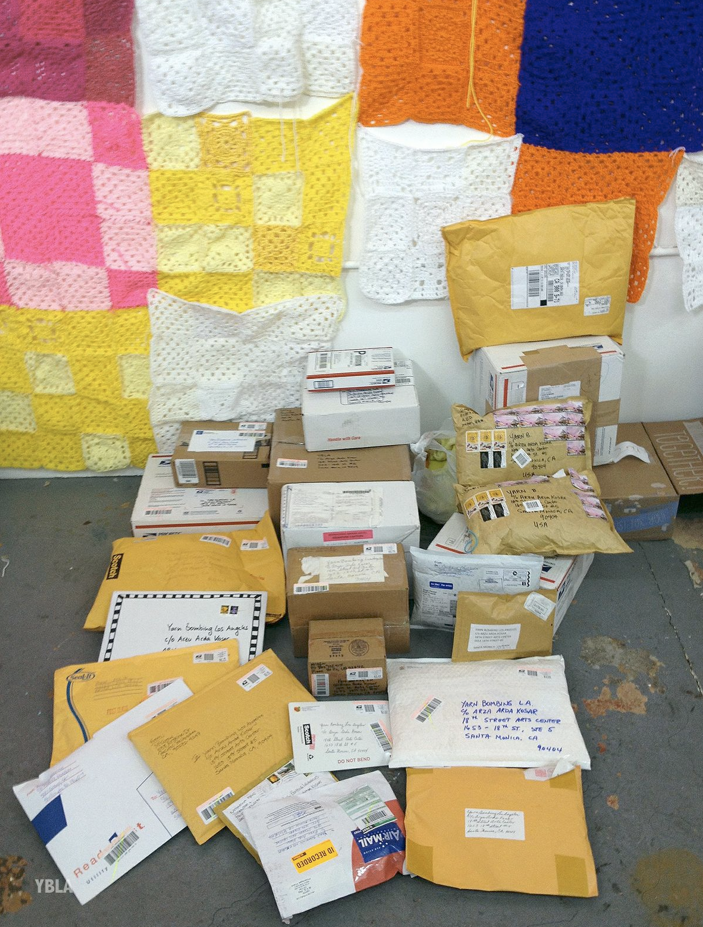
Darlyn Susan Yee, a TAG artist since 2007, is part of a unique public art project: CAFAM Granny Squared. Her group, Yarn Bombing Los Angeles, has covered the facade of the Craft and Folk Art Museum with hand worked granny squares that were contributed from all over the world.
[all photos courtesy of Yarn Bombing Los Angeles]
We asked her some questions about Granny Squared:

How does it feel to pull off such a large project?
Very rewarding to have a chance to work on a project with over 500 artists and crafters from 49 states and 25 countries! As a core member of Yarn Bombing Los Angeles (YBLA), I’ve had the opportunity to assist with many aspects of the CAFAM: Granny Squared project.
Explain how you crowd sourced.
In October 2012, we received the green light from the Craft And Folk Art Museum and began collaborating on crocheted modular design elements. We refined these elements during our business meetings and with others during public outreach sessions at the museum. With a definite installation plan in mind, YBLA distributed a call for 5 inch x 5 inch granny squares in specific colors.
The LA Times and LA Street Art Gallery wrote articles about our plans, and we began receiving lots of granny square submissions. Documentation of the squares received was the most labor intensive but vital part of the project. When people saw images of their friends’ squares, they became even more excited about submitting their own! Once we saw that we would reach the targeted number of squares, we began hosting stitching parties and events to assemble the squares into sections, and then stitch the sections onto metal frames. In the final weeks before installation an intern joined us to post our call for essays about our project, and to launch a YBLA twitter account.
Did social media play an important role?
Which platforms did you use?

Social media was definitely the key to expanding our community. We used the Yarn Bombing Los Angeles website and newsletter, Facebook, and Twitter. We also reached out to artists and crafters with more specific interests through Ravelry, LinkedIn Groups and Meetup groups.

Any surprises?
While I am generally happy working on my artwork in the solitude of my studio, I found myself craving the social aspects of this project: the public outreach events; actually meeting the friends of friends and followers; the lively discussions around the table as we learned about each other and our shared interests.

Explain the crowd funding process.

In December 2012, we launched a two-month fundraising effort through USA Projects. The pressure was on - if we didn’t meet our fundraising goal, we wouldn’t have received anything. But our ever growing community of artists and crafters wanted to make the project happen as much as we did!

Since this was an installation on a public building, how did you get permits?
YBLA hired a structural engineer and contractor for the project so we had a bit of help in navigating the permit process. Their expertise proved invaluable as we prepared for meetings with city and county officials. I believe the biggest hurdle we faced was that a temporary project like this had never been done before. There was no precedent, therefore it was challenging to pin down the applicable codes.
I hear you received a surplus of granny squares. What's happening with them?
For the second phase of the granny square project YBLA is partnering with Downtown Women's Center (DWC). We will be creating blankets for DWC residents out of the extra squares. We will also be creating a series of public installations on the facade of the DWC building that includes a series of Urban Letters installations and another granny square arrangement. We will also be developing a product that DWC residents can produce and sell in the DWC store MADE, and working with the women to develop skills related to product making.
What's next?
We expect the granny square project to continue through December 2013. In the meantime, we will be coordinating stitching events to turn squares into blankets. Our next special event is a Stitch-In for International Yarn Bombing Day at One Colorado Old Pasadena on Sunday June 9th, 11am-2pm. And we meet at the Craft And Folk Art Museum on the 3rd Saturday of every month from 2-5pm.
Granny Squared will be installed on the Craft and Folk Art Museum 
at 5814 Wilshire Boulevard Los Angeles, CA 90036 until July 1st.
Read more here.


Friday, June 7, 2013

TAG Interviews Joe Pinkelman

Joe Pinkelman is exhibiting paintings and ceramics in his show New Work: The Heaven and Hell Series.
He answered some questions from us:

Are there any challenges working with the artisans in Jingdezhen, China?
In general, Jingdezhen has been great because it is a place where you come in with an idea and you have incredible technicians that help you realize that idea in ceramic form. They literally have 1000 years of experience behind them. It isn't a challenge working there because it is very first world in environment so all of your needs are met.
Self Portrait #1, stoneware, wire, 21 x 15 x 10"
You have a couple of 2d drawings in this show. 
Is this something new for you? Or work that you just haven't exhibited at TAG before?
I've always worked in a 2-D medium so I wanted to include some images in this recent show.
Trees #1, oil/charcoal on paper, 44 x 33"
Has your day job influenced your art?
My job doesn't influence my work, rather various life experiences.

What is the biggest challenge that you face as an artist? 

I think ceramics is a very abstract medium like poetry and music, yet unfortunately in our culture it (ceramics) goes quite unappreciated except as a craft medium. That however doesn't deter me from working in the medium.

Do you have some questions for Joe?
Come ask him at the Artists' Talk at TAG on Saturday, June 8, 3-4pm.
The show runs until May 15th.
There will be a closing reception on Saturday, May 15th from 4-5pm.

Tuesday, June 4, 2013

TAG interviews Andrea Kichaven

+ & - / Textured Terrain is Andrea Kichaven's current show at TAG.
On Saturday, June 8, she will be at the gallery to talk about her work.
We asked her a few questions:

What excites you about the medium/genre that you work? 
My excitement for a new piece begins with the canvas size and the blank canvas. I look at all the canvases and one will just speak to me, as if it is saying, "paint me!" I am not afraid of the blank canvas. The first thing I do is layout the page and divide it into sections. I suppose this is my graphic design background speaking.
Una Nueva Vida (Renewed Life), 2013 Mixed media on canvas, 36 x 36"
Can you share about your technique? Or is it a secret?
The title of my current show is + & - / Textured Terrain. The + & -, or addition and subtraction, refers to my process of layering color and texture. My grounds are made with texturing pastes and gels to create texture. Then I build color and texture one layer at a time. Once I add a layer of color, I quickly wipe away most of it and then seal it so that I can add another layer. This process goes on for many layers (10-30). My hope is to have fragments of each layer coming through from beneath, leaving a history and creating depth. Often, more texturizing layers are added for more depth. Complementary colors are used to add harmony and unify the different textures throughout the piece. I believe that my work in monotypes (a type of printmaking) inspired me down this road of experimentation of textures, colors, and layers.

How do you know when a work is finished? 

I generally don't know where I am going and I rely on my instincts during the process. Eventually the piece tells me when it is finished, and whether the environment I have created needs an animal or not. I have a collection of animals (hand painted photographs, illustrations, renderings, paintings) and if the piece calls for an animal, I will add it. I prepare the animals separately so that I don't spoil the grounds I have created thus far.
Traves de la Bahia (Across the Bay), 2013, Mixed media on canvas, 24 x 24"
Tell us about your studio -- where do you create?
My studio is my converted two-car garage. I generally work on three to four pieces at a time, so I also utilize the garden tables for drying between layers.

What would you like your viewers to take away from their encounter with your artwork? 
I hope that the textures and colors draw the viewer into these abstract environments and provoke their imaginations and curiosity.

This is your first show at TAG. Have you had any surprises? 
Becoming a member of TAG has been a wonderful experience. I am enjoying the camaraderie of the other artists and the professionalism of the gallery.


Do you have some questions for Andrea?
Come ask her at TAG on Saturday, June 8, 3-4pm.

Tuesday, May 28, 2013

TAG Interview with Suki Kuss

Suki Kuss is exhibiting mixed media collages at TAG that take the viewer through an abstract narrative.
We asked her some questions about her work. 
Night Music I, 2013, mixed media collage, 10 x 10"
How do you decide on the elements that are in your work?
What attracts you to the them?
I love vintage fibers, fabrics, lace and sheet music...I combine these elements with plexi glass, mirrors and mosaic glass to express a ageless quality in my work.

As a collagist, you must have a lot of stuff. Are you Joseph Cornell (organized and tidy) or Francis Bacon (messy)?
I'm both....and am always secure in the knowledge that, within my vast amount of treaures, I know exactly what I need and can always find it...

Tell us about your studio -- where do you create?
I have a studio but prefer working in the sun room in my home...the light is fabulous. I often wake at 3 or 4am and wander into this special place...the quiet yet intense time of day often helps me make dramatic decisions and changes within my work.

How or why is a made by hand, one of a kind art piece important?
It's an intimate conversation with the creator/artist. There is no other way to see deeply into another individual.

What would you like your viewers to take away from their encounter with your artwork?
A sense of completeness...a question answered and a question asked...

Suki's work will be on view through Saturday, June 15.
She will be participating in an Artists' Talk at TAG on Saturday, June 8, 3-4pm


Thursday, May 9, 2013

TAG Interview with Brigitte Schobert

Kaleidoscope is Brigitte Schobert's current show at TAG.
On Saturday, May 11, she will be at the gallery to talk about her work.
We asked her a few questions:

This is a very different body of work that you're showing.
Tell us how you came to this.
I did not have a show last year and in the previous show in Sept 2011 most of my work was already non-representational.
Untitled 161, 2012, oil on paper, 26 x 26"
Is this a new way of working or are you returning to media that you used in the past?
For the "oil on paper" I still use a printmaking procedure and apply the oil paint by means of an etching press. However, it is a process that I developed for myself and it is different from the traditional way of printmaking.
     
What is your process?
In my acrylic painting I apply a lot of unorthodox means as well, like sponges, sponge cloth, rags, sand and the like and sometimes combine printing and painting.

Untitled 172, 2012, acrylic on Canvas, 30 x 20"
How do you decide on your color palette?
I am trying not to get hung up on similar colors. For example after a picture with blue I want to make a painting where red or yellow prevails. It is only the direction in general and might be modified while the painting is developed.

How do you know when a work is finished?
A painting is finished when the the picture does not "speak" to me anymore. Even when I don't paint I put my picture in a position where I can see it, because I walk by many times from different directions. Often I know something is still missing, but not quite what it is. I wait until I know. Whenever a picture does not create the feeling it still needs something, it is considered finished and stowed away.

What is the biggest challenge that you face as an artist?
Every new picture is a challenge and a struggle, sometimes the way is more twisted than other times, but it is never straight. I do not work from a preconceived sketch or model, but develop the image step by step and make new decisions at every step. This way I never know how, where and when it ends and there are always surprises.

Brigitte's work can be seen at TAG until May 18.
Her artist talk is May 11.