Showing posts with label Darlyn Susan Yee. Show all posts

Wednesday, February 5, 2014

TAG at Palm Spring Fine Art Fair

In a week, ten TAG artists are headed to the Palm Springs Fine Art Fair, Booth 111.
A limited number of reserved tickets are available either a VIP PASS (+1, every day) or a single DAY PASS. Info and links follow below.

VIP PASS gives you and a guest access to
Every day of the fair February 14-16
+ Opening Preview Thu Feb 13, 7-9:30pm

LINK

DAY PASS gives you access to
Any 1 day of the fair February 14, 15 or 16
LINK

Show schedule
Thursday Feb 13, 7:00-9:30pm
Friday Feb 14, 11am-8pm
Saturday Feb 15, 11am-8pm
Sunday Feb 16, 11am-6pm

Location
Palm Springs Convention Center
277 N Avenida Caballeros
Palm Springs CA 92262

MAP 
Artists participating:
Anne M Bray
Christo Brock
Katie Crown
Cynthia Alexander
Pam Douglas
Peter Kempson
Suki Kuss
Gary Polonsky
Lina Sue Price
Darlyn Susan Yee
 
We hope to see you there!

Sunday, June 9, 2013

TAG Interviews Darlyn Susan Yee

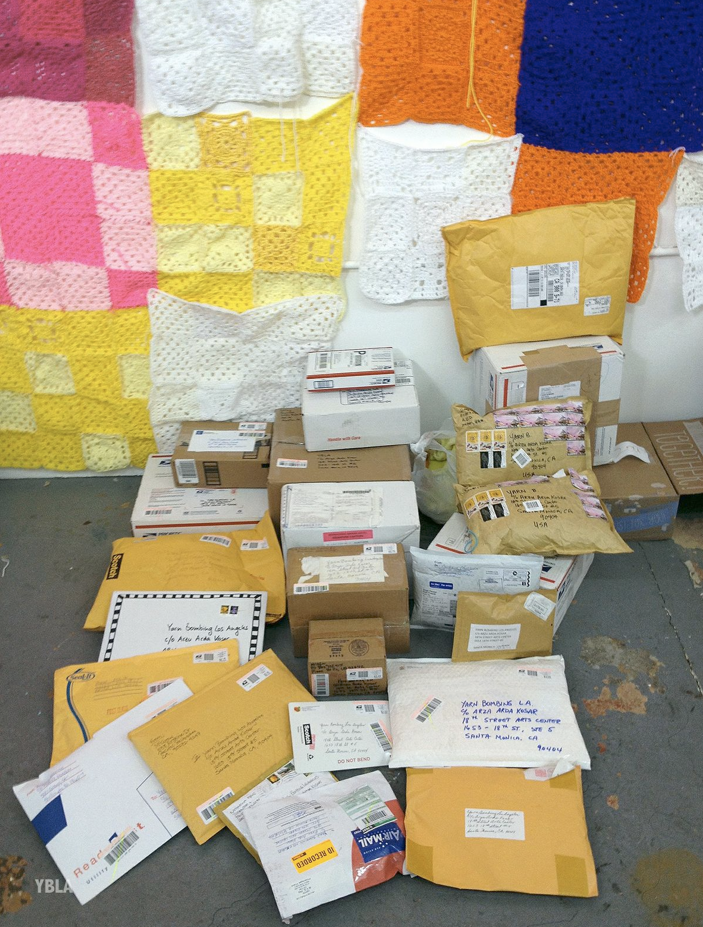
Darlyn Susan Yee, a TAG artist since 2007, is part of a unique public art project: CAFAM Granny Squared. Her group, Yarn Bombing Los Angeles, has covered the facade of the Craft and Folk Art Museum with hand worked granny squares that were contributed from all over the world.
[all photos courtesy of Yarn Bombing Los Angeles]
We asked her some questions about Granny Squared:

How does it feel to pull off such a large project?
Very rewarding to have a chance to work on a project with over 500 artists and crafters from 49 states and 25 countries! As a core member of Yarn Bombing Los Angeles (YBLA), I’ve had the opportunity to assist with many aspects of the CAFAM: Granny Squared project.
Explain how you crowd sourced.
In October 2012, we received the green light from the Craft And Folk Art Museum and began collaborating on crocheted modular design elements. We refined these elements during our business meetings and with others during public outreach sessions at the museum. With a definite installation plan in mind, YBLA distributed a call for 5 inch x 5 inch granny squares in specific colors.
The LA Times and LA Street Art Gallery wrote articles about our plans, and we began receiving lots of granny square submissions. Documentation of the squares received was the most labor intensive but vital part of the project. When people saw images of their friends’ squares, they became even more excited about submitting their own! Once we saw that we would reach the targeted number of squares, we began hosting stitching parties and events to assemble the squares into sections, and then stitch the sections onto metal frames. In the final weeks before installation an intern joined us to post our call for essays about our project, and to launch a YBLA twitter account.
Did social media play an important role?
Which platforms did you use?

Social media was definitely the key to expanding our community. We used the Yarn Bombing Los Angeles website and newsletter, Facebook, and Twitter. We also reached out to artists and crafters with more specific interests through Ravelry, LinkedIn Groups and Meetup groups.

Any surprises?
While I am generally happy working on my artwork in the solitude of my studio, I found myself craving the social aspects of this project: the public outreach events; actually meeting the friends of friends and followers; the lively discussions around the table as we learned about each other and our shared interests.

Explain the crowd funding process.

In December 2012, we launched a two-month fundraising effort through USA Projects. The pressure was on - if we didn’t meet our fundraising goal, we wouldn’t have received anything. But our ever growing community of artists and crafters wanted to make the project happen as much as we did!

Since this was an installation on a public building, how did you get permits?
YBLA hired a structural engineer and contractor for the project so we had a bit of help in navigating the permit process. Their expertise proved invaluable as we prepared for meetings with city and county officials. I believe the biggest hurdle we faced was that a temporary project like this had never been done before. There was no precedent, therefore it was challenging to pin down the applicable codes.
I hear you received a surplus of granny squares. What's happening with them?
For the second phase of the granny square project YBLA is partnering with Downtown Women's Center (DWC). We will be creating blankets for DWC residents out of the extra squares. We will also be creating a series of public installations on the facade of the DWC building that includes a series of Urban Letters installations and another granny square arrangement. We will also be developing a product that DWC residents can produce and sell in the DWC store MADE, and working with the women to develop skills related to product making.
What's next?
We expect the granny square project to continue through December 2013. In the meantime, we will be coordinating stitching events to turn squares into blankets. Our next special event is a Stitch-In for International Yarn Bombing Day at One Colorado Old Pasadena on Sunday June 9th, 11am-2pm. And we meet at the Craft And Folk Art Museum on the 3rd Saturday of every month from 2-5pm.
Granny Squared will be installed on the Craft and Folk Art Museum 
at 5814 Wilshire Boulevard Los Angeles, CA 90036 until July 1st.
Read more here.


Monday, September 3, 2012

New Exhibit at TAG Gallery Carol Kleinman, Gary Polonsky, Darlyn Susan Yee
September 4 - September 29, 2012


Opening Reception: Saturday, September 15, 2012, 5-8 p.m.
Conversation with the Artists: Saturday,September 22, 2012, 3-4 p.m.

Carol Kleinman Reflecting Reality

Photographer Carol Kleinman documents reflections. Her goal is to capture the many layers of fleeting reality she finds on reflective surfaces. Each reflection is a moment in time - a slice of reality that exists for a second. Kleinman prints her images on canvas rather than paper to blur the line between photography and painting taking the mysterious nature of her work further toward the edge of reality. Combining reality with mystery is very important in Kleinman's work. She does not add, layer or combine in her images. She feels if she were to manipulate the serendipitous reality she finds in the world, the impact would be lost. What you see is what she saw.

Gary Polonsky New Work in the Food Series

 In his latest exhibition, artist Gary Polonsky further explores large-scale still life painting, focusing his most recent work on classic American confections. Working from real food while using non-traditional canvases of balsa wood, styrofoam, and wire mesh, Polonsky’s three-dimensional works break the surface and effectively blur the line between painting and sculpture. “I figure out how to build the physical 3D object, which essentially becomes my canvas,” says Polonsky. “Some pieces require quite a bit of engineering to figure out how to build the object so that it will last.” Magnifying his subjects’ detail, Polonsky’s wall-based constructions echo themes of nostalgia while beckoning viewers to take a closer look at an array of tantalizing sugary treats - just short of taking an indulgent bite.

Darlyn Susan Yee Re: Fashion

Darlyn Susan Yee's latest exhibition, Re: Fashion explores fashion and attire. Using exaggerated conceptual styles, larger than human sizes, and repurposed materials she playfully challenges traditional roles of family, gender and consumerism. Her latest works inject traditional methods of cloth and garment construction with exciting vinyl, acrylic and polyester flagging, barricade, audio and correction tapes. With a wry smile, Yee comments on the desire to conceal perceived flaws and alter the human form. “I am so excited by the energetic colors and textures I can achieve through use of alternative materials,” explains Yee. “Although these works are not intended to be worn, I've been approached to create customized wearable art for specific events and fundraisers.”

Monday, August 27, 2012

TAG Interview with Darlyn Susan Yee

Darlyn Susan Yee
The Red Dress 2006 Photo by Hugh Hamilton 
Knitted Plastic, 74" h x 15" w x 12" d
Your work includes knotting and knitting, as well as crocheting. Are there other ways that you use fiber and other materials in your work? What are they? Where do you get them? Do these other techniques change your work in any way? Or, vice versa, have changes to your work resulted in exploring new materials? 

 I really enjoy placing traditional fiber methods in a new context. For my Alternative Material Series, the selection of barricade, flagging ad audio tape drives the concept of the final project. Created from string, the works in my Knotted Sculpture Series are smaller, with meticulous detail in both form and structure. In my Body Cocoon Series, I use amazing commercially produced specialty yarns with the more flexible techniques of knitting and crocheting to represent the various shapes of the human form. And in my Public Art practice, the visual impact, duration of the installation and exposure to the elements influence my material selections.

Yarn bombing has become a trend…Tell us a little about public yarn bombing? What is the motivation, the history, what issues are involved? How is it different than vandalism, than seasonal decoration? Does the yarn bombing you participate in require a permit? Do you ever worry about being sent to jail like “Revoke” or “LA II”?) 

 Yarn bombing is a temporary public art form - a non-damaging urban intervention. Most of the projects I've worked on have been in collaboration with Yarn Bombing Los Angeles. We've created installations at the Craft and Folk Art Museum and 18th Street Art Center. In response to the earthquake and tsunami in Japan, we collaborated on the Empathy Circle displayed at the Union Center for the Arts in Little Tokyo. On the closing weekend of Art in the Streets, we yarn bombed our cars outside Geffen Contemporary at MOCA to show a softer side of graffiti. And during the College Art Association Conference, we participated in Un-Space Ground by creating and dispersing pillows inscribed with Wish I Were Here in front of the Los Angeles Convention Center adding a warm texture and color to the otherwise sterile environment.

The immediate feedback while working on a yarn bombing project is so exciting. And applying the technical skills in a different way has been freeing. With any form of expression, there is a risk that others will not receive the message in the way it was intended. Response to Yarn Bombing Los Angeles projects has been favorable, and with each installation we mount comes another idea or opportunity. Some yarn bombing projects are sanctioned and involve permissions, site plans, permits, insurance, etc. Other projects and collaborations happen more organically. In both cases, we take responsibility for returning the public space to its original state.

Darlyn Susan Yee
Hot Mamma Apron 
Crocheted Plastic, 2012  64" h x 62" w x 3" d
What do your newest creations say about the human form? Are you considering making pieces so that they are wearable? (Do you flirt with the idea, but stop at that boundary…if so, why stop at that line? Is the distinction between wearable art and sculpture important to you? Why or why not?) 

Re: Fashion, my upcoming exhibition at TAG Gallery, is about fashion and attire, though these works are not intended to be worn. Using exaggerated conceptual styles, larger than human sizes, and repurposed materials I playfully challenge traditional roles of family, gender and consumerism. It has been quite fun to play with the energetic colors and textures to create these new artworks.

Girls play with fashion dolls that often have lots of bright pinks in their wardrobes. In reality, pink is a difficult color for a woman to wear and be taken seriously. With Hot Mamma Apron and Hot Mamma Mitt, I juxtapose the frivolous feminine pink with the impact of plastic fluorescent flagging tape most often used by construction workers.

In what ways does your work speak to the various cultures of Southern California? How would you like it to affect them? 

Whether showing my work in a gallery or museum, or installing it as public art, the familiar voice of fiber begins the conversation. The common thread woven through all cultures is the sense of home and place. Without regard to location, social status, culture or gender, everyone recognizes the processes because they know someone who knits sweaters at family functions, or crochets baby booties, or creates beautiful knotted necklaces. When people see my artwork in a different context, it sparks dialogue about fiber methods in the contemporary context, and at a more base level, about our upbringing, home, and comfort.

Darlyn Susan Yee Photo by Wyatt Conlon
Detail of Edyth Wyle Square Knots 
Two Knotted Knit Cord Banners 
as installed at Craft and Folk Art Museum, 2012 
48" h x 26" w x 1"d each

 Darlyn Susan Yee's exhibition opens September 4, 2012.

Tuesday, February 1, 2011

New Exhibition Featuring Joan Horsfall Young, Darlyn Susan Yee, and Fielden Harper

TAG PRESENTS
New Exhibition Featuring
Joan Horsfall Young, Darlyn Susan Yee, and Fielden Harper

February 1 - February 26, 2011

Reception:
Saturday, February 5, 5- 8 PM

Artists' Q & A Panel:
Wednesday, February 9, 7 PM


Joan Horsfall Young: abc...z

In her latest exhibit, abc...z, local artist Joan Horsfall Young explores the beauty in simplicity with her 12" x 12" oil paintings of fruits and vegetables, depicting one for each letter of the alphabet. Her series of twenty-six images celebrates what she calls "the great sustainers of life." Young's inspiration for this series came from her recent visit with her granddaughter in Shanghai. She explains "I needed a way to teach my young granddaughter the American alphabet, and I found the fruits and vegetables in the local farmer's market to be great didactic tools for teaching. In the first days we conquered 'T' for tangerine and 'L' for leek." As a follow up for more practice for the little one, Young started to paint the vegetables and fruits as they went along. "I learned a lot about conscious eating and how these everyday market treats could nourish our bodies and our souls. I hope these paintings will capture that same nostalgia for others too."

Darlyn Susan Yee: Metamorphic Metaphors

In her new exhibition, Metamorphic Metaphors, Darlyn Susan Yee creates a series of body-like cocoons knitted with brightly colored commercial yarns to symbolize our essence, style, and transformation as we proceed through life. Suspended from the ceiling, each piece mimics the cocoon of a not-yet-hatched butterfly swaying with the breeze to evoke thoughts of dance or play. "In each piece, I try to explore how our personalities and physical characteristics are still evident despite our efforts and societal requirements to conceal them," explains Yee. Ms. Yee prefers using hands-on processes to achieve the breadth of texture and form in this series, combining both hand knitting and manually manipulated machine knitting techniques.


Fielden Harper: Parallels

In Parallels Fielden Harper explores thematic similarities between her local landscape and distant scenes from Greece and Turkey. After a recent trip to Greece and Turkey, Harper was inspired to juxtapose scenes from both areas with well known landmarks from her own hometown. "There were many scenes in my travels that reminded me of similar places in and around Santa Monica. As different as these places seemed on the surface, the artist in me started to see the universal patterns emerging in the disparate," explains Harper. Creating unique pairings of two separate paintings, Harper invites her viewers to discover the universal essence emerging from two seemingly different vistas like the Getty and the Parthenon; or the skyline of Istanbul and the towering palms of Santa Monica. "It is amazing to be on the other side of the world, and be continually reminded of home," states Harper.

Monday, January 17, 2011

Darlyn Susan Yee Interview

Clockwise from top left are selections from Darlyn Susan Yee’s three bodies
 of fiber artwork: Tying The Knot (detail), Body Cocoon No. 4, and
Security Blanket.
Hand knitting and manipulated machine knitting techniques are combined to create Darlyn Susan Yee’s Body Cocoon series.

In a prior interview you discussed your knotted work, which is what you are most known for. Are you still working the same way, or has there been a shift?

I’ve been working simultaneously to expand three distinct bodies of fiber work. In each, I apply traditional fiber methods to create three-dimensional forms. I continue to enjoy knotting the most. It is also the most detailed, representational and labor intensive work I create. Some of my knitted sculptures are a bit more portable at certain stages of their life cycles. This portability makes them ideal to stop and start when I am traveling. I'm also working on a series of knitted projects using and cast-off and obsolete materials such as barricade tape, correction tape, etc. These range from wall-hung pieces to freestanding sculptures.

You are still working with fiber, but how is the knitting different than the knotting?

My sculptural knotting is done with multiple strands or lengths of fiber hand tied together to form the fabric surface.

My hand knitting is generally created by using two needles and a length of yarn or string resulting in a fabric structure of interlocking loops. I also incorporate other tools, which replicate the movement of the yarn across the needles to create this flexible fabric.

What is hand manipulated machine knitting? Are these pieces hand knit, or by machine? Will you elaborate on your process?

Knitting on the machine I use is similar in nature to weaving on a hand loom. It relies on my hands to move the needles into the desired positions, and then to move the carriage across the needles to create the fabric. Once I remove the fabric from the machine, I manipulate stitches and add more knit or crochet to contour and finish the piece.

I understand that some of these pieces are just returning from an exchange exhibition in Slovakia, can you tell us about that? What was exchanged? What was the experience like? Did you go to Slovakia?

After Hours/Individual Stories was an exchange project between Orange County Center for Contemporary Art in Santa Ana and Galéria Z in Bratislava, Slovakia. It was exciting to assist in unpacking the crates of Slovakian artwork for display at OCCCA. And it was so wonderful to meet some of the Slovak artists in attendance at the exhibition. Unfortunately, I was unable to travel to Slovakia, but from the reception photos, the artwork sent by OCCCA artists was as well received as the Slovakian artwork was received here in the US.

What's next?

I really enjoy fiber processes. I plan to continue applying traditional techniques to take my work in exciting new directions. I’m in the design phase on a very large-scale project. And I'm anxiously awaiting the publication of my first book, MacramĂ© Today: Contemporary Knotting Techniques, in July 2011.

Darlyn Susan Yee


Darlyn Susan Yee's exhibition opens February 1, 2011.

Monday, June 21, 2010

Darlyn Susan Yee, Carol Kleinman, and Betty Sheinbaum: June 22- July 17, 2010


TAG Gallery Announces

New Exhibit Featuring Works By
Darlyn Susan Yee, Carol Kleinman, and Betty Sheinbaum

June 22- July 17, 2010

Reception: Saturday, June 26, 5-8 PM

Artist Talk: Saturday, July 10 at 3 PM


Contained!, Darlyn Susan Yee

Although Darlyn Susan Yee has been creating containers in various media since childhood, for the last twelve years she's been stimulated by the textures that the knotting process yields. Through her study of the human form and character, Darlyn realized that we judge others by their appearances and attire, or their own personal containers. Fascinated by its simplicity and raw beauty, Darlyn has chosen cotton fiber for this series. Employing the basic knots - Lark's Head, Overhand Knot, Half Hitch, Clove Hitch and Reef Knot - she has created non-functional objects of art to be enjoyed and passed to future generations. Darlyn has hand-built each piece knot by knot, just as one would shape or form a clay object. Utilizing the knot structures and fiber properties, she has encouraged the final shape of each unique sculpture.


Paris Reflections, Carol Kleinman

Carol Kleinman is known for her unique ability to capture and highlight the "mystery in the mundane" through her bold, unmanipulated single digital exposures printed on canvas. In her latest exhibit, Kleinman's creative use of window reflections that capture images from inside and outside at the same time, allows her to depict the complexities of Paris life while simultaneously drawing out universal human themes. Whether or not one has ever traveled to Paris, Carol's work provides a gateway to get lost in the moment and discover the multiple realities that present themselves to us, but so often get overlooked as we rush through life. These reflections provide an emotional glimpse into the life, the charm, and the soul of one of the most beautiful cities in the world.


People, Betty Sheinbaum

Betty Sheinbaum is neither a struggling newcomer nor a jaded veteran. Coming to art seriously in the 1950s, long before feminism carved the freedom for women to select and juggle roles, Betty has led a full, complex life packed with "other concerns." Nonetheless, she is a true artist. Betty's latest series, People, goes beyond mere portraits and explores her subjects on a deeper level. She captures them mid-activity in order to translate onto the canvas how the participants are pouring out their hearts and souls. For the last 40-odd years, Betty Sheinbaum has worked in painting, sculpture and weaving.

Monday, June 7, 2010

An Interview With Darlyn Susan Yee


Does Knot Hold Water I
knotted cotton 10-1/2 x 7-1/2 x 7-1/2"
Darlyn Susan Yee


From hand-tied knots in cotton, Darlyn Susan Yee constructs intricate versions of seemingly everyday objects.

At what point in your life did you decide to be an artist?

I don’t think I really decided. It decided for me. I started entering some of my craftwork into fairs. From there it was recommended to me that I should put some work in galleries and that the best way to do that would be to enter competitions. So I started getting my feet wet there. And that’s how it all started happening.

Is the craftwork you started with related to what you do now?

I started knotting when I was about 9 years old. That’s the one constant throughout my life. That’s my favorite medium. I also paint and have done some paintings that have sold, but I’m thrilled by the knotting and what I can do with it. It’s a guilty pleasure in a way to be able to do what I want to do.

How did you learn knotting?

I was at summer day camp and we started on basic knots to form things around the campsite. We made a belt and a little pendant and all sorts of little decorative items and I thought that’s really cool, I could do a lot with that. Since then no string was ever safe with me again.

What is it about the string, or the knots that you like?

I like the ability to make a fabric, to make a structure, to construct something. I am really in a way hand building my forms, knot-by-knot, piece-by-piece and choosing the knots that will help it to stand up, that will help it to move in a certain way. There aren’t many people who knot structurally. Jane Sauer is really my inspiration. She currently has her own gallery. Her work is hard to find online, but she has pieces in the Smithsonian American Art Museum and the Museum of Arts and Design.

Can you share about your technique? Or is it a secret?

It’s not a secret. In fact I’m working on a book right now about the knotting techniques. It is a “how to” and has a segment that has some of my artwork. I was really lucky to be tapped - right after being included in 100 Artists of the West Coast II, one of the editors wanted me to write this book. I’ve never written a book. So again, I’m trying something I’ve never done, but I’m really enjoying the process. It’s causing me to analyze everything that I do: “Why is this not working, why am I still doing it?” It’s been enlightening to go back to the basics and find the words to describe what is second nature to me.


Excessively Handled
knotted cotton 13-1/2 x 8-1/2 x 8-1/2"
Darlyn Susan Yee

Do you have an idea in mind before you start about what it’s going to look like?

I have a general plan. I don’t work from patterns or anything like that. I’m an anti pattern person. I like trying to build something. Awhile back I looked at a tree and I said, “I bet I could make that in knots”. And I made an abstract knotted tree that people do recognize is a tree.

How often do you start a new work?

Not often enough. I get sidetracked by gallery work, various obligations, family things. At this point I haven’t been starting new pieces more than once every three months and completing them about once a year. They really are time consuming. What normally happens to me is that I get a burst of desire to complete - right around show time. I pull a few all nighters and get it all finished. I decide what’s the closest and I often have to set a piece aside because it’s not clear where it needs to go next. Everything lives in a corner somewhere and I pull out a piece when I see what I need to do with it. And I always work faster on a deadline. I grew up in magazine publishing and the idea of the deadline and how do I get to that point from here. I have to set my own deadlines in order to get things accomplished.

Is there any separation between your "normal" life and your artwork? If so, how do you manage to keep each in its place?

I really strive to do work at work and as soon as I leave I can put on the other hat. I try and keep it really separate and distinct – I wouldn’t want my employee doing something else on the side while I was paying them.

There’s a lot to being an artist that isn’t about doing the actual work. There’s the website, there’s trying to develop some sort of blog, I’ve been hammered recently, “Why aren’t you on Facebook? Why aren’t you Twittering?” If I had eight arms and maybe four brains I could do all that. There’s a lot that goes into it. I realize that I’ve had accumulated a lot of knowledge about the various pieces along the way. The skills I’ve acquired in my normal life have informed my work and life as an artist, and vice versa.

Do you find that your own life experience plays a role in your imagery?

Sometimes. I know that some of the first few pieces that I created I could correlate to dreams that I had, that I really wanted to flesh out. Not everything though. More of my recent work is just things, trying to represent things and people and thoughts, clearing out the clutter in my brain with all those projects that I’ve wanted to do. The last several years have been about clearing the clutter in my life. Part of moving is reassessing, “What did I have this for? Why haven’t I used it again,” and clearing some of that out, finding new uses for things, finding new ways to express using the tools that I have.

Does art serve a function beyond decoration?

Yes. I think most artists will say the same thing – that it’s meditative. They get into a groove, they get going, and where does the time go? I have to set an alarm to tell myself to do other things if I allowed myself, I would procrastinate on everything else. I’d rather be knotting, but the balance of activities is better for me in the long run.


Darlyn Susan Yee


Darlyn Susan Yee's exhibition at TAG Gallery opens June 22.